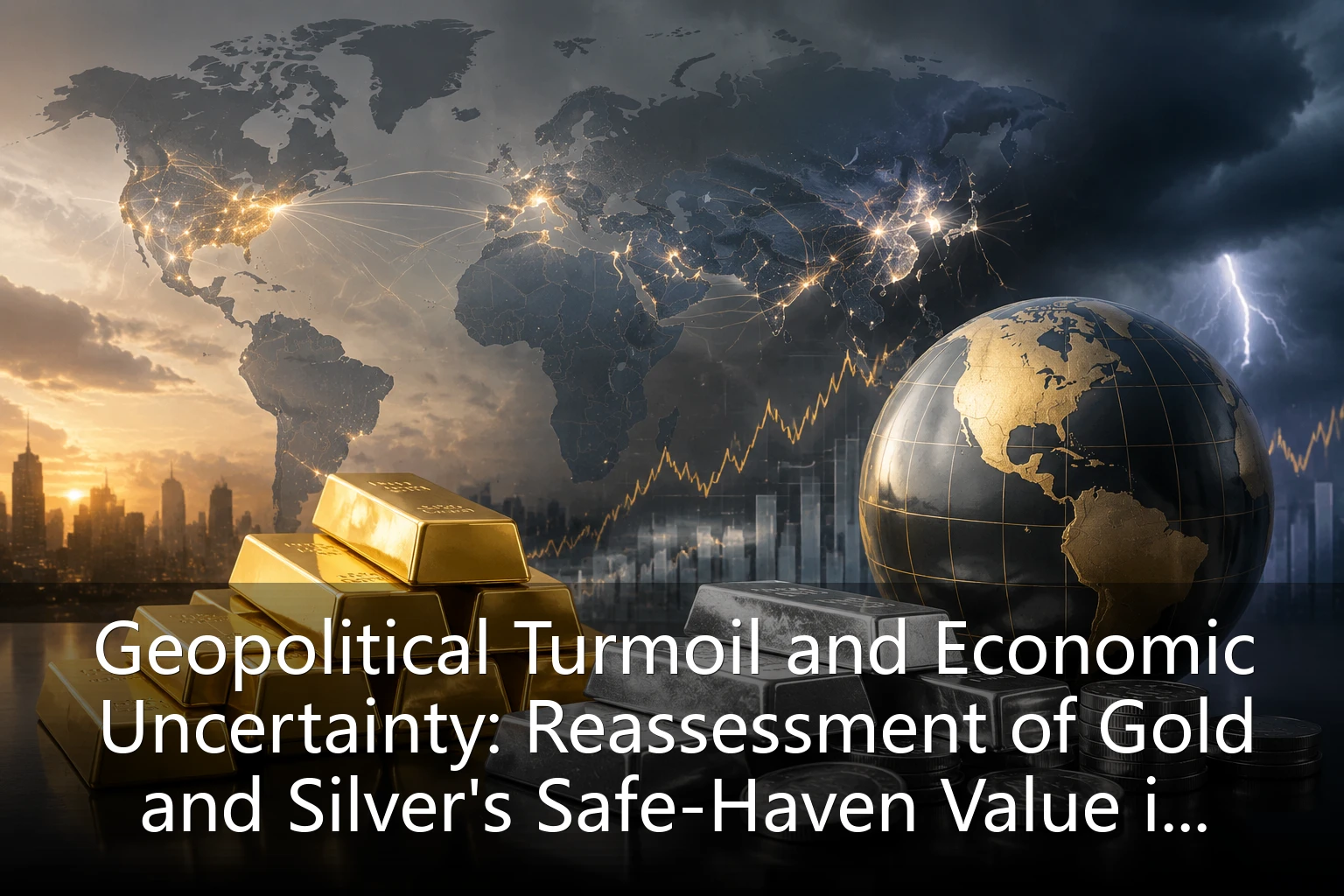
Geopolitical Turmoil and Economic Uncertainty: Reassessment of Gold and Silver's Safe-Haven Value in 2026
\nIn the context of continued global economic turbulence in 2026, investor demand for safe-haven assets has reached unprecedented heights in recent years. With escalating geopolitical tensions, persistent inflationary pressures, and increasing uncertainty about economic growth prospects, gold and silver, as traditional safe-haven assets, have once again garnered significant market attention. This article will conduct an in-depth analysis of the safe-haven attributes of gold and silver in the current environment, and how investors can effectively utilize this asset class for risk management and asset allocation.
\n\nEvolution of Global Geopolitical Landscape and Surge in Safe-Haven Demand
\nThe international geopolitical environment in 2026 presents unprecedented complexity and uncertainty. Continuing escalation of conflicts in multiple regions, rising protectionism, and intensifying great power competition have all brought substantial risks to the global economy. Against this backdrop, investor demand for assets that can provide stable value preservation has significantly increased.
\nAs the oldest safe-haven assets in human history, the value of gold and silver often becomes more pronounced during periods of global turmoil. Historical data shows that whenever international tensions escalate, gold prices tend to rise. For instance, during periods of heightened regional conflicts, gold prices have increased by an average of 8-12%, demonstrating their effectiveness as safe-haven assets.
\n\nAnalysis of Gold and Silver's Safe-Haven Value Under Economic Uncertainty
\nIn addition to geopolitical factors, the multiple uncertainties facing the global economy today also support the safe-haven attributes of gold and silver. Major economies continue to face inflationary pressures, which, while lower than the peaks of 2022-2023, remain above central bank target levels. This inflationary environment erodes the purchasing power of fiat currencies, making the value of gold and silver as physical assets more prominent.
\nFurthermore, signs of a global economic slowdown are increasingly evident. Manufacturing PMI indices in multiple countries continue to hover below the threshold, and consumer confidence indices are declining, all of which heighten investor concerns about economic recession. Against a backdrop of slowing economic growth, gold and silver, as non-correlated assets, can effectively diversify portfolio risks and provide stable returns.
\n\nCentral Bank Gold Purchasing Surge: Official Safe-Haven Signals
\nNotably, central banks worldwide are continuously increasing their gold reserves. According to the latest data from the International Monetary Fund (IMF), global central banks purchased a record 450 tons of gold net in the first half of 2026, a 35% increase year-on-year. This trend indicates that central banks are viewing gold as an important strategic reserve asset to cope with an increasingly complex international financial environment.
\nThe gold purchasing behavior of central banks carries significant market signaling implications. As professional institutional investors, central bank decisions are often based on judgments about long-term economic trends. Their continuous gold accumulation reflects official concerns about future economic uncertainty and financial system risks, while also providing solid official endorsement for the safe-haven value of gold and silver.
\n\nQuantitative Analysis of Gold and Silver's Safe-Haven Value
\nFrom a quantitative perspective, the safe-haven value of gold and silver can be evaluated through multiple indicators. First, correlation analysis between gold/silver and traditional financial assets shows that during periods of economic turmoil, their correlation with stocks, bonds, and other traditional financial assets often decreases, sometimes even turning negative, making them effective tools for portfolio diversification.
\nSecond, the risk-adjusted performance of gold and silver also warrants attention. Historical data shows that during economic recessions and financial crises, gold's average return rate is significantly higher than that of the stock market, while its volatility is relatively lower, demonstrating favorable risk-adjusted return characteristics. Although silver is more volatile, it can also provide substantial investment returns when supported by strong industrial demand.
\n\nGold and Silver Allocation Strategies for Different Investment Scenarios
\nFor investors with different risk preferences and investment objectives, gold and silver allocation strategies should also vary. For conservative investors, 5-10% of assets can be allocated to gold as a "safety cushion" for the portfolio, providing stable returns during periods of economic uncertainty.
\nFor balanced investors, a "core-satellite" strategy can be adopted, allocating 3-5% of assets as core holdings in gold, while flexibly allocating 1-2% to silver based on market conditions to capture excess returns driven by silver's unique industrial demand.
\nFor aggressive investors, while maintaining a 3-5% allocation to gold, they can increase the silver allocation ratio to 5-8%, while monitoring the gold-silver price ratio. When the ratio is at historically high levels, increasing silver allocation can capture relative value investment opportunities.
\n\nGold and Silver Safe-Haven Investment Opportunities in Singapore's SGX Market
\nAs an important precious metals trading center in Asia, the Singapore Exchange (SGX) offers investors a rich array of gold and silver investment tools. Gold and silver futures contracts on SGX feature high liquidity and transparency, serving as important channels for investors to participate in safe-haven precious metals investment.
\nNotably, SGX's gold and silver delivery mechanism provides the possibility of physical delivery, which is particularly important in extreme market conditions. When systemic risks emerge in financial markets, physical gold and silver can provide ultimate liquidity assurance, an advantage that paper assets cannot match.
\n\nPractical Recommendations for Gold and Silver Safe-Haven Investment
\nFor investors interested in safe-haven investment through gold and silver, the following practical recommendations are worth noting:
\n- \n
- Diversified Allocation: Do not allocate all safe-haven funds to a single metal. Reasonably distribute the allocation between gold and silver based on market conditions and personal needs. \n
- Regular Rebalancing: Set fixed rebalancing periods. When price fluctuations cause allocation ratios to deviate from targets, adjust promptly to maintain risk exposure. \n
- Consider Physical Holding Costs: For physical gold and silver investment, consider storage, insurance and other holding costs, and evaluate the actual long-term investment returns. \n
- Utilize Derivatives for Hedging: For large investments, consider using futures, options and other derivatives for risk hedging to reduce price volatility risks. \n
Conclusion: Long-Term Outlook on Gold and Silver's Safe-Haven Value
\nOverall, in the current environment of escalating geopolitical turmoil and economic uncertainty, the value of gold and silver as safe-haven assets is being reassessed. Whether viewed from historical performance, central bank behavior, or market indicators, gold and silver demonstrate unique safe-haven attributes, capable of serving as a "stabilizer" in investment portfolios.
\nHowever, investors should also recognize that gold and silver investment is not without risks. Factors such as price volatility, liquidity risks, and opportunity costs need to be fully considered in investment decisions. Through appropriate allocation strategies and professional risk management, gold and silver can indeed provide effective protection and long-term value growth in the current complex and ever-changing economic environment.
\nAs the global economic landscape continues to evolve, the safe-haven value of gold and silver will also face new challenges and opportunities. Investors should maintain close attention and adjust investment strategies in a timely manner to fully capture the investment value of gold and silver as safe-haven assets.