South Korea's Stock Market Crash Warning: How Structural Risks Are Amplified from the KOSPI Circuit Breaker
Keywords: South Korea Stock Market; KOSPI; Samsung Electronics; SK Hynix; Circuit Breaker; Leveraged ETF; Retail Investor Dominance
Introduction
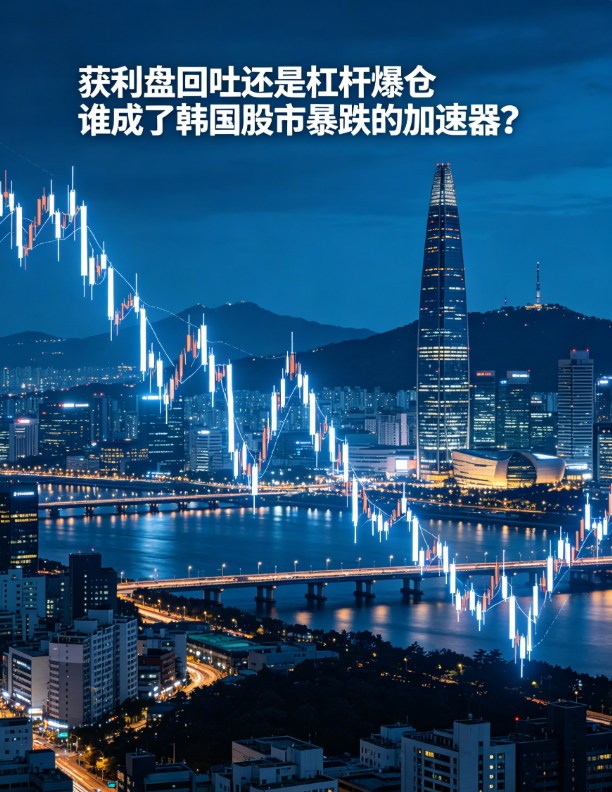
On June 23, the Korea Composite Stock Price Index (KOSPI) triggered a circuit breaker during trading, eventually closing down 9.99%, recording a rare single-day crash in recent times. Samsung Electronics and SK Hynix, the two major heavyweight stocks, both plunged, falling over 12%, sharply reversing market sentiment. Notably, this severe correction was not triggered by a sudden deterioration in fundamentals, but rather appeared to be a systemic correction triggered by overvaluation, imbalanced capital structure, and leveraged trading resonance. For the South Korean stock market, which had been on a strong rally, this crash was not just a price fluctuation, but a concentrated exposure of the market's fragile structure.
1. The Crash Is Not a 'Black Swan', but an Inevitable Shock After High Valuation
Before the crash, KOSPI had broken through 9,000 points, with the market full of optimistic expectations for the semiconductor cycle recovery and AI demand explosion. However, according to reviews by institutions like Goldman Sachs, the rise was supported not by continuously improving earnings fundamentals, but by technical trading, liquidity-driven momentum, and positive feedback from chasing prices. In other words, the higher the index rose, the more passive the buying became, until marginal funds were exhausted, and the market quickly lost balance at a certain critical point.
Particularly noteworthy is that KOSPI has long been heavily dominated by Samsung Electronics and SK Hynix, with excessive weight concentration making the index highly tied to a few leading stocks. When market expectations for these two stocks become overly consistent, any profit-taking can quickly evolve into a cascading index-level decline. This crash shows that the upward logic of the South Korean stock market has gradually shifted from 'fundamentals-driven' to 'emotion-driven'.
2. Retail Investor Dominance and Leverage Expansion Amplify the Speed and Magnitude of the Decline
The core risk of this volatility in the South Korean stock market lies in its unique investor structure. In recent years, retail investors have occupied an increasingly important position, and under the lure of returns, margin trading and leveraged product usage have risen significantly. Data shows that in June, margin debt in South Korea rose to historical highs, meaning many investors used borrowed funds to chase gains during the rise, making forced liquidation highly likely once prices fell.
During the June 23 trading session, selling was not evenly distributed but accelerated as the market dropped. Some market participants pointed out that forced liquidation sell orders in the afternoon session significantly amplified the decline. Meanwhile, foreign and institutional investors chose to reduce positions, while retail investors counter-cyclically bought the dip, superficially showing enthusiasm for 'bottom-fishing', but in reality further increasing the fragility of market chips. The combination of high-level buying and leveraged funds meant that the volatility was no longer simply a 'correction after a rally', but had clear characteristics of passive deleveraging.
3. Leveraged ETFs Act as Volatility Amplifiers
If margin trading was the accelerator of this crash, leveraged ETFs were the important amplifiers. As Samsung Electronics and SK Hynix stock prices continued to rise, single-stock leveraged ETFs tracking these two stocks attracted substantial funds. While appearing to provide a more efficient investment tool, they actually further financialized and amplified market volatility.
South Korean regulators have recently publicly expressed regret over allowing the issuance of such leveraged ETFs, because retail investors account for a very high proportion of users, with significantly inadequate risk awareness. ETFs are supposed to serve a risk-diversification function, but in the South Korean market, some ETFs have evolved into high-risk trading tools concentrated on semiconductor leaders. More seriously, as the trading scale of these products expands, any pullback can trigger a chain reaction of rebalancing, redemptions, and program trading, forming a negative cycle of 'decline - liquidation - further decline'.
4. Three Lessons from the South Korean Stock Market for Global Markets
First, the divergence between valuation and expectations will eventually correct. No matter how clear the long-term logic, once stock prices rise much faster than earnings can deliver, systemic risks accumulate. Second, when market structure is more fragile than fundamentals, volatility is often amplified by the index. The case of the South Korean stock market shows that excessive weight concentration and high retail investor leverage significantly weaken market stability. Finally, financial innovation, if detached from risk constraints, can shift from 'improving efficiency' to 'creating volatility'. Leveraged ETFs are not inherently problematic, but they require stricter investor suitability management and risk warning mechanisms.
Conclusion
The KOSPI crash is not an isolated event but a concentrated exposure of long-term structural problems in the South Korean stock market. It reminds the market: when a rise depends mainly on capital flow, trading tool amplification, and emotional resonance, any external shock can quickly evolve into a sharp decline. For investors, this adjustment reveals a simple but important principle - what truly determines the long-term resilience of a market is not how amazing the short-term gains are, but whether it has sufficiently stable capital structure, reasonable valuation foundation, and tolerable risk boundaries.