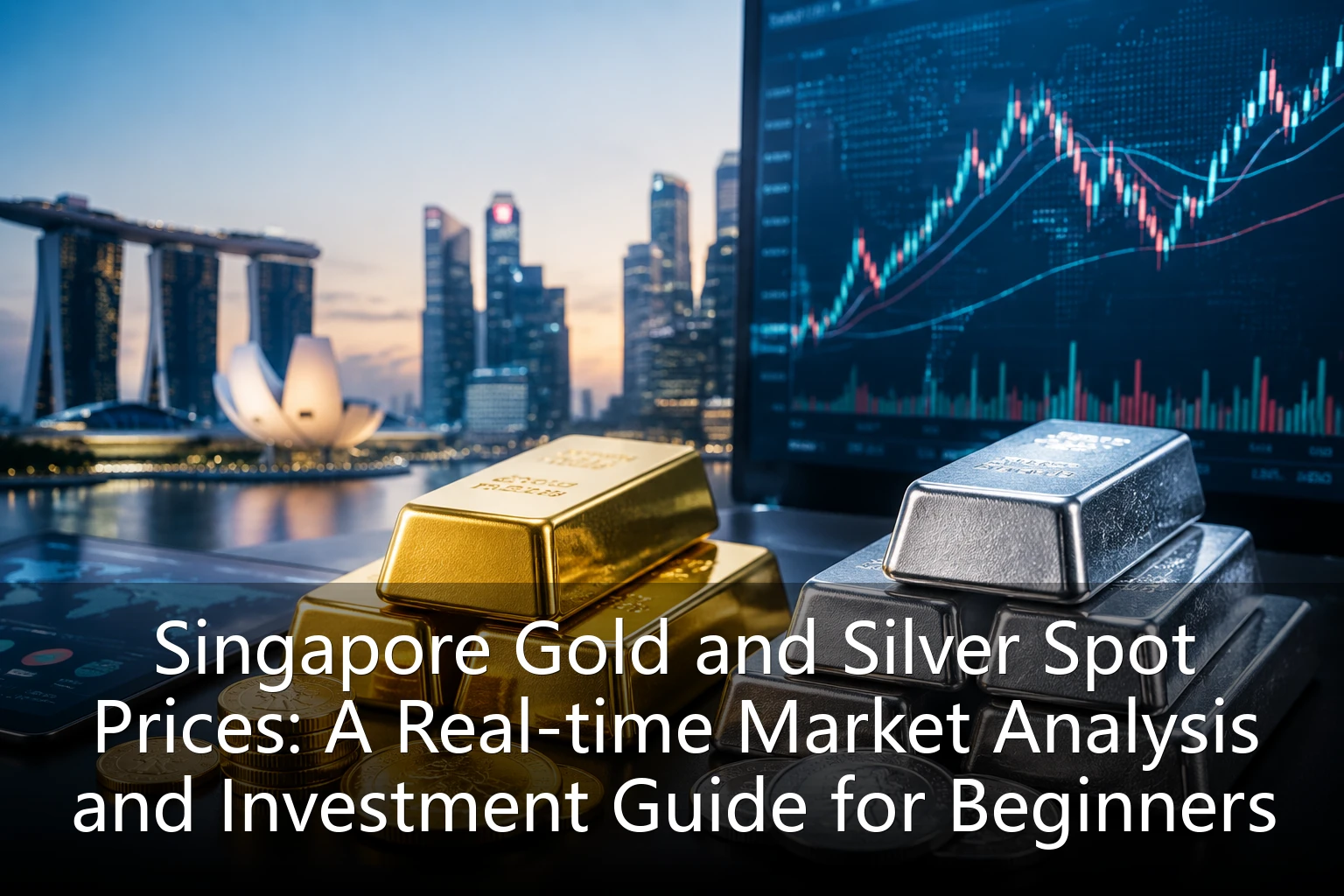
Gold and silver, as traditional safe-haven assets and investment tools, have spot prices (Instant Price) that are key references for investor decisions. For beginners, understanding the meaning, access channels, and influencing factors of "gold and silver spot prices" is the first step in participating in precious metals trading. This article will use the Singapore market as an example to deeply analyze the essence of gold and silver spot prices, debunk common misconceptions, and explore their application scenarios in actual investment, helping readers build a comprehensive understanding of real-time market conditions.
1. What are Gold and Silver Spot Prices? Core Concept Analysis
Gold and silver spot prices, also known as "real-time prices" (Real-time Price), refer to the latest transaction prices or quotes of precious metals at a specific market and time. Unlike "closing prices" or "opening prices," spot prices are dynamic, reflecting the current market's supply and demand and investor sentiment. Taking Singapore as an example, the Singapore Exchange (SGX) is one of the world's important precious metals trading markets, and its gold and silver spot prices are mainly reflected through the real-time quotes of SGX's precious metals contracts (such as gold futures, silver futures).
It should be noted that spot prices are usually divided into "bid price" (Bid Price) and "ask price" (Ask Price), and the difference between them is called "spread" (Spread). The bid price is the price at which investors sell precious metals, and the ask price is the price at which they buy. The smaller the spread, the lower the transaction cost.
1.1 Access Channels for Spot Prices
- Exchange official website: The SGX official website updates gold and silver futures quotes in real time, including bid price, ask price, and trading volume information.
- Market analysis software: Such as MetaTrader, TradingView, etc., can connect to the SGX market to display real-time trends and spot prices.
- Financial media: Financial platforms like Bloomberg, Reuters synchronize gold and silver spot prices from major global markets, including the Singapore market.
- Broker platforms: Investors can directly view real-time quotes of SGX gold and silver contracts through their broker's trading accounts.
1.2 Key Factors Influencing Gold and Silver Spot Prices
- Macroeconomic data: Such as US non-farm payroll data, CPI, GDP growth, etc., affect market expectations of the Federal Reserve's monetary policy, thereby influencing gold and silver prices. For example, if non-farm data is better than expected, the US dollar may strengthen, and gold and silver prices may fall; conversely, they may rise.
- Geopolitical risks: Events like wars and political turmoil increase the safe-haven demand for gold and silver, pushing prices up. For example, when Middle East tensions are high, gold and silver spot prices often rise rapidly.
- US dollar exchange rate: Gold and silver are priced in US dollars. When the dollar strengthens, gold and silver prices usually fall; when the dollar weakens, they rise.
- Supply and demand: The production and consumption of gold and silver (such as jewelry demand in India and China), central bank gold purchases, etc., affect the supply-demand balance, thereby influencing spot prices.
- Market sentiment: Investors' panic or greed can amplify price fluctuations. For example, when market risk aversion rises, gold and silver spot prices may surge quickly.
2. Common Misconceptions: Misunderstandings About Gold and Silver Spot Prices
2.1 Misconception 1: Spot Price is the Final Transaction Price
Many beginners think that the spot price they see is the transaction price when they trade, but in reality, the spot price is the market's quote, not the transaction price. The transaction price depends on the investor's order type (such as market orders, limit orders) and market liquidity. For example, if an investor buys gold with a market order, the transaction price may be slightly higher than the current ask price; if using a limit order, the transaction price will not exceed the set limit.
2.2 Misconception 2: Spot Prices Are the Same Across All Markets
Gold and silver spot prices vary across different markets because each market has different trading hours, participant structures, and liquidity. For example, the trading hours of the Singapore market (9:00 AM to 5:30 PM) overlap with the New York market (8:00 PM to 2:00 AM), but the New York market has greater liquidity and more volatile price fluctuations. Therefore, investors need to focus on the spot prices of the market they trade in (such as SGX), not the prices of other markets.
2.3 Misconception 3: Spot Prices Have Small Fluctuations and Are Suitable for Short-term Trading
In fact, gold and silver spot prices can fluctuate greatly, especially during major data releases or geopolitical events. Short-term trading requires attention to the fluctuation range and trend of spot prices, but it is not suitable in all cases. For example, in calm markets, spot prices fluctuate little, and the profit space for short-term trading is limited; in volatile markets, the risk is also higher.
2.4 Misconception 4: Ignoring Time Zone Effects
Singapore is in the UTC+8 time zone, with time differences from New York (UTC-5) and London (UTC+0). For example, when the New York market opens, the Singapore market may have already closed, and at this time, Singapore's gold and silver spot prices may not be updated. Investors need to pay attention to the interconnection of global markets to avoid information lag caused by time zones.
3. Characteristics and Applicable Scenarios of Singapore Gold and Silver Spot Prices
3.1 Characteristics of the Singapore Market
- Trading hours: SGX gold futures (GC) trade from Monday to Friday, 9:00 AM to 5:30 PM (Singapore time), and silver futures (SI) trade from 9:00 AM to 5:00 PM. The overlapping period with the New York market (9:00 AM to 5:00 PM) has the highest liquidity, and spot prices fluctuate more during this time.
- Contract specifications: SGX gold futures contracts are 100 ounces per lot, and silver futures are 5000 ounces per lot. The contract size is relatively large, suitable for institutional investors, but individual investors can participate through mini contracts.
- Capital flow: SGX's metal capital flow data (e.g., SGX metal capital flow tag id:616) can reflect the buying and selling directions of market participants. For example, if capital flows into gold futures, it may push spot prices up.
- Delivery rules: SGX's precious metals delivery rules (tag id:609) stipulate that when futures contracts expire, investors can choose physical delivery or cash settlement. Physically delivered gold and silver must meet specific standards (such as purity, weight).
3.2 Applicable Scenarios
- Short-term trading: Utilize the overlapping period between the Singapore and New York markets, focus on the fluctuation trend of spot prices, and conduct intraday trading. For example, if gold spot prices rise rapidly after the New York market opens, investors can buy gold futures in the SGX market and sell after prices rise further.
- Arbitrage opportunities: Find arbitrage opportunities by comparing gold and silver spot prices across different markets. For example, if Singapore's gold spot price is lower than New York's, investors can buy in Singapore and sell in New York to earn the price difference (considering transaction costs and time zones).
- Hedging investment: When geopolitical risks or economic uncertainties arise, gold and silver spot prices often rise. Investors can buy gold and silver futures or spot as hedging tools. For example, if Middle East tensions are high, Singapore's gold spot price may rise rapidly, and investors can buy in time.
- Ratio analysis: Analyze the gold-silver ratio (gold price/silver price) to determine which precious metal has more investment value. For example, if the gold-silver ratio is at a historical high, it may mean silver is undervalued, and investors can buy silver; if it is low, gold may be undervalued, and buy gold.
4. How to Use Gold and Silver Spot Prices for Investment Decisions
4.1 Combining Technical Analysis
Technical analysis is a method of using historical price and volume data to predict future trends, applicable to the analysis of gold and silver spot prices. Common technical indicators include moving averages (MA), relative strength index (RSI), Bollinger Bands, etc. For example, if the gold spot price breaks through the moving average, it may indicate a trend reversal, and investors can consider buying.
4.2 Focusing on Fundamental Data
Fundamental data is a core factor influencing gold and silver spot prices. Investors need to pay attention to the release times of important data (such as US non-farm data released on the first Friday of each month) and prepare for trading before the data release. For example, if non-farm data is expected to be better than expected, investors can sell gold before the data release to avoid price drops.
4.3 Risk Control
Regardless of the type of trading using spot prices, risk control is crucial. Investors should set stop-loss orders (Stop Loss), which automatically sell when the price falls to a certain level to prevent losses from expanding. For example, if the spot price of buying gold futures is $1800/ounce, a stop-loss price of $1780/ounce can be set to limit losses to within $20/ounce.
4.4 Long-term Investment vs Short-term Trading
Gold and silver spot prices are more suitable for short-term trading, while long-term investment requires focusing on the long-term trends of gold and silver. For example, if investors believe gold has long-term safe-haven value, they can ignore short-term spot price fluctuations and hold gold spot or futures contracts to wait for long-term appreciation.
5. Summary
Gold and silver spot prices are a core reference for precious metals trading. Understanding their meaning, influencing factors, and common misconceptions is key to investors' success. As a globally important precious metals market, Singapore's gold and silver spot prices have unique characteristics. Investors need to combine market characteristics, technical analysis, and fundamental data to formulate appropriate investment strategies. Whether it is short-term trading, arbitrage, or hedging investment, cautious decision-making and risk control are necessary to gain profits in the gold and silver market.