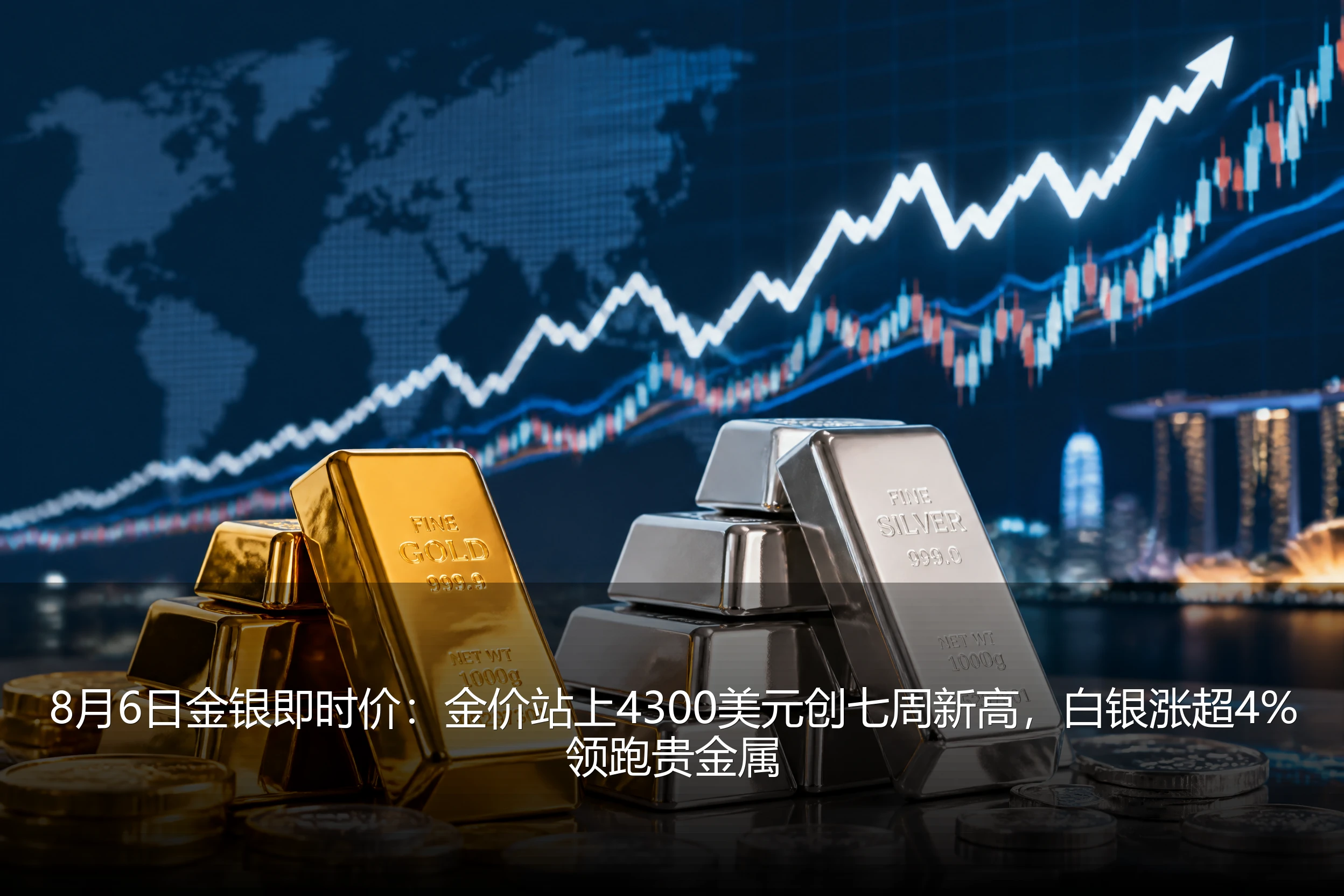
Singapore Gold Prices Hit Record High: Geopolitical Risks and Inflation Expectations Drive Gold Price Through Historical Barrier
On August 9, 2026, Singapore's gold market reached a historic moment. As global geopolitical tensions intensified and inflation expectations in major economies rose, the gold futures price on the Singapore Gold Exchange (SGX) broke through historical barriers, reaching a new high of $2,650 per ounce. This breakthrough not only reflects the continued market demand for gold as a safe-haven asset but also marks the further enhancement of Singapore's position as an Asian gold trading center.
Singapore Gold Prices Break Through Historical Barrier
According to the latest data from the Singapore Gold Exchange, as of the close on August 9, 2026, gold futures prices closed at $2,650/ounce, an increase of over 15% since the beginning of the year, setting a record high since the exchange's establishment. Silver futures prices also rose simultaneously to $31.5/ounce, with a year-to-date increase of 20%.
As an important gold trading center in Asia, Singapore's gold price trends often lead the regional market. Behind this price breakthrough, multiple factors are at work, including continuous gold purchases by global central banks, rising geopolitical risks, strengthening inflation expectations, and fluctuations in the US dollar index.
Global Central Bank Gold Purchase Surge Drives Demand Growth
Since 2026, the global central bank gold purchase surge has continued to intensify. According to the latest report from the World Gold Council, global central banks' net gold purchases reached a record 650 tons in the first half of the year, a year-on-year increase of 35%. As an Asian gold hub, Singapore has also attracted central banks from multiple countries to increase their gold reserves through the local market.
Notably, central banks in Southeast Asian countries are accelerating gold reserve diversification. According to data from the Singapore Monetary Authority, in the first half of 2026, Southeast Asian central banks increased their gold reserves through the Singapore market by more than 200 tons, accounting for nearly one-third of global central bank gold purchases. This trend has not only enhanced the liquidity of Singapore's gold market but also increased its voice in global gold pricing.
Dual Drivers of Geopolitical Risks and Inflation Expectations
In 2026, the global geopolitical landscape has continued to be tense, with increased uncertainty in the Middle East, Eastern Europe, and the Asia-Pacific regions, prompting investors to turn to traditional safe-haven assets like gold. As an important financial center in Asia, Singapore's gold market has become the preferred channel for regional investors to avoid risks.
Meanwhile, inflationary pressures in major economies persist. The latest US inflation data shows that although the inflation rate has moderated, it remains above the Federal Reserve's 2% target. Many European and Asian countries also face similar inflationary pressures, which further enhances gold's attractiveness as an inflation hedging tool.
Singapore's Gold Market Infrastructure Continues to Improve
The Singapore Gold Exchange has continuously improved its market infrastructure in recent years, enhancing trading efficiency and transparency. In 2026, SGX launched a new generation of gold trading systems, supporting 24-hour continuous trading, and introduced more diversified gold derivatives, including mini gold futures, gold options, etc., to meet the needs of different investors.
In addition, the Singapore government has introduced several policies to support the development of the gold market, including optimizing gold tax policies, simplifying gold import and export procedures, and strengthening gold market supervision. These measures have not only attracted more international investors to participate in Singapore's gold market but also enhanced its international competitiveness.
Technical Analysis and Future Outlook
From a technical perspective, after breaking through the key resistance level of $2,650, gold prices may continue to rise in the short term. Technical indicators show that gold's Relative Strength Index (RSI) is above 70, indicating that the market is in an overbought state, but strong upward momentum may push prices to further challenge the psychological barrier of $2,800.
However, analysts also remind investors to pay attention to potential risk factors. First, if US economic data performs better than expected, it may prompt the Federal Reserve to maintain a hawkish stance, putting pressure on gold prices. Second, if the US dollar index rebounds, it may also negatively affect US dollar-denominated gold prices. In addition, a slowdown in global central bank gold purchases or a easing of geopolitical tensions could also affect gold's safe-haven demand.
Investment Strategy Recommendations
For investors, the current high volatility in the gold market provides abundant trading opportunities, but risk management needs to be prudent. The following are several possible investment strategies:
- Long-term Allocation Strategy: For long-term investors, the value of gold as a safe-haven asset and inflation hedging tool remains significant. It is recommended to allocate gold assets between 5%-10% of the investment portfolio to balance overall risk.
- Short-term Trading Strategy: For short-term traders, you can focus on technical breakthroughs and callback opportunities in gold prices. It is recommended to set stop-loss orders to control single transaction risks within 2% of total funds.
- Diversified Investment: In addition to physical gold and gold futures, investors can also consider related assets such as gold ETFs, gold mining stocks, etc., to achieve portfolio diversification.
International Position of Singapore's Gold Market
As a leading gold trading center in Asia, Singapore's international position is continuously improving. According to data from the London Bullion Market Association (LBMA), Singapore's gold trading volume accounted for 15% of global gold trading volume in 2025, ranking third globally, second only to London and New York.
The Singapore government plans to further expand the scale of the gold market, with the goal of developing Singapore into an Asian gold pricing center and gold asset allocation hub by 2030. This strategy will not only consolidate Singapore's position in the Asian financial market but also provide more liquidity support to the global gold market.
Conclusion
In August 2026, Singapore's gold market achieved a historic breakthrough, with gold prices reaching an all-time high. Behind this breakthrough are multiple factors including the global central bank gold purchase surge, geopolitical risks, and inflation expectations. With the continuous improvement of Singapore's gold market infrastructure and international status, Singapore is expected to continue leading the development of the Asian gold market, providing more trading opportunities and investment choices for global investors.
For investors, the current high volatility in the gold market brings both challenges and opportunities. While paying attention to gold price trends, it is also necessary to rationally assess risks and formulate reasonable investment strategies to grasp the long-term investment value of the gold market.